New cartoon series aims to simplify understanding of addiction
In Episode 1- “The Hijacker,” learn about how substance use disorders
(SUDs) affect tissue function in two main parts of the brain:
i - the limbic
system (responsible for basic survival instincts) and
ii - the prefrontal
cortex (where decision-making and impulse control live).
Substance use activates the dopamine process in the survival center much
more powerfully than natural rewards like food or sex.
When repeated it
can hijack the brain, making it think that the substance is the most
important thing for survival.
Over time, more and more of the substance is needed to activate the same
level of reward, causing the brain’s circuits to become increasingly
imbalanced --eroding a person’s self-control and ability to make sound
decisions, while producing intense impulses to seek and use the
substance.
This is what it means when scientists say that addiction is a brain
disease.
The good news – SUDs are preventable and treatable, and brain scans show
that once an individual is in recovery, brain tissue can get better.
“ADDICTION” is an animated video series that turns the science on
substance use disorder (SUD) and addiction into stories that stick.
Want to learn more? Need help? Worried about a loved one?
Visit the ARC
www.addictionresourcecenter.org
Animated by Patrick Smith
Produced by the Addiction Policy Forum
Written by Maureen Boyle, PhD, Braeden Kelly, Jessica Hulsey Nickel, and
Lisbet Hope Portman.
Thanks to the National Institute on Drug Abuse (NIDA) for the science
highlighted. https://www.drugabuse.gov/
Enjoying alcohol in moderation is not just "not bad" for you, but it
may have health benefits that could prolong your life. It is when people
use alcohol as an escape route for social, personal or career pressures
that abuse or alcoholism can result. Abuse of alcohol, or consumption
of more alcohol than the body can handle, can lead to liver damage and other debilitating conditions. Alcohol abuse can also lead to alcoholism--diagnosed as alcohol use disorder
in the latest Diagnostic and Statistical Manual (DSM-5)--or alcohol
addiction, in which a person becomes physically and psychologically
dependent on alcohol to the point that he or she cannot function without
it. Alcohol abuse and addiction can also lead to destructive behavior
such as driving under the influence of alcohol and domestic violence.
According to the
US Substance Abuse and Mental Health Services Administration,
in 2013, 18.0 million people age 12 years or older in the US needed
treatment for alcohol use (6.9% of Americans age 12 or older).
Short-term Effects of Alcohol
Most adults will experience no detrimental effects from one or two
servings of alcohol a day. A serving is a four-ounce glass of wine, a
12-ounce can of beer or a 1.5-ounce shot of a distilled spirit. This
level of consumption may even decrease the risk of cardiovascular
disease and dementia.
Short-term effects of doses of alcohol above that safe level, which
differs for people depending upon weight and whether they consume on an
empty stomach, begin with relaxation and reduced inhibitions. While
these
effects[/link]
may be pleasant, they then progress to lowered concentration, lowered
reflex and response time and poor coordination, all of which result from
a slowdown in the activity of the brain.
Short-Term Effects of Alcohol Use
Slurring of speech.
Drowsiness.
Emotional changes.
Sleep disruption.
Lowering of body temperature.
Symptoms of Excess Alcohol Intake
Nausea and vomiting.
Loss of bladder and bowel control.
Blackouts, in which a drinker does not remember what happened while he or she was drinking.
Temporary loss of consciousness.
Coma and death.
Any short-term effect of alcohol can be amplified when alcohol is
consumed in conjunction with other mind-altering substances including
both legal and illegal drugs. People who are using medication for pain
or treatment of psychological conditions should not even consume alcohol
in moderation without consulting their doctors.
Video: Causes of Alcoholism
Credit: Howcast
Side Effects
The side effects of alcohol include the hangover, in
which headaches, nausea, and vomiting continue after a drinker is no
longer actually intoxicated or experiencing the alcohol high. Weight gain and high blood pressure can result from repeated overconsumption of alcohol, and long-term overconsumption of alcohol can raise the risk for:
Depression.
Liver damage.
Cancer.
Depression of the immune system.
Reduced sexual performance.
Alcohol use can also have serious consequences for
expecting and
breastfeeding mothers and their babies, including fetal alcohol syndrome.
Long-Term Effects of Alcohol
Long-term overconsumption of alcohol causes death of brain cells, which can lead to brain disorders as well as a lowered level of mental or physical function.
Liver damage from alcohol can result in cirrhosis, a severe medical condition that can require a liver transplant to treat.
Long-term overconsumption of alcohol can cause pancreatitis, a very dangerous inflammation of the pancreas, and it can also cause nerve damage. Tolerance, a long-term effect of alcohol in which
the body becomes accustomed to higher and higher doses of alcohol after a
long period of overconsumption. This makes it possible for long-term
drinkers to consume amounts of alcohol that are dangerous without
experiencing short-term effects that might otherwise convince them to
stop. Tolerance can lead to dependence and then to addiction or
alcoholism in some individuals.
Alcohol Dependence
Alcohol dependence, or alcoholism, occurs when the body cannot
function without alcohol. Alcohol affects certain neurotransmitters in
the brain. When the brain becomes accustomed to the way that alcohol
affects these brain chemicals, it can no longer send proper signals to
the rest of the body without the presence of alcohol. Once someone has developed a dependence on alcohol, he or she
will continue to drink regardless of any serious physical symptoms
caused by alcohol. In addition, a person who has developed
alcohol dependence will continue to drink even if he or she suffers
social or personal circumstances such as the loss of a job or career,
breakup of personal relationships, or arrests for behavior related to
alcohol consumption.
Am I Addicted to Alcohol?
Withdrawal Treatment
Alcohol dependence is a physical disorder that requires medical
treatment, as attempts to withdraw alcohol from a dependent patient will
lead to unpleasant and even potentially dangerous withdrawal symptoms. Medical treatment for alcohol dependence is known as detoxification, or detox, and it is followed by
inpatient or
outpatient rehabilitation treatment and therapy that helps patients avoid future alcohol abuse.
Alcohol Addiction Most Treated of all the Substances
Ethanol (alcohol) is abused at a higher rate than any other drug
among treatment program attendees, as reported by a 2017 survey from
Recovery Brands.
Nearly 70% of people who took the survey went to treatment to get
help with a drinking problem, and a surprising 52.87% of those who
responded reported seeking treatment for a problem with alcohol more
than any other substance. No matter how many substances of abuse there
are, the one that causes the most extensive harm is ethanol.
If you or someone you love is
addicted to alcohol, you are not alone, and there is
help available.
In a residential rehab center, intensive counseling
and therapy that helps patients find positive ways of dealing with the
stress and pressures that led them to abuse alcohol begins as soon as
the acute detoxification process is over.
Residential treatment programs lasting from 30 days including detox
to 90 days and beyond are available at rehab centers that are located in
pleasant surroundings where patients can focus solely on recovery. Once
the inpatient phase of treatment is complete, counselors at these
centers encourage patients to continue treatment with outpatient addiction professionals as well as by joining self-help support groups such as Alcoholics Anonymous.
When most people think of health, they think of the condition of
their body and its organs. Alcohol abuse causes damage to a number of
organs and systems in the body, and these conditions are well
documented. Some of the more notable effects of alcohol on the body
include a breakdown of the digestive system, tissue damage in the
digestive tract, and an inability to properly absorb nutrients. The
circulatory system can also be seriously affected resulting in high
blood pressure, heart disease or stroke.
Alcoholism can also have more intangible effects on your life. It
often damages relationships with family and friends. With an addiction,
the alcohol becomes more important than anything or anyone in your life.
Addiction to alcohol changes
your priorities and your demeanor. Relationships are damaged when
alcohol affects your behavior and comes between you and the people you
love. It is impossible to build and nurture a healthy relationship and
uphold your responsibilities to the people in your life while you are in
the throws of addiction.
Short-Term Effects of Alcohol
Alcohol begins to affect your brain from the very first drink. The
high you feel from consuming alcohol is the result of its influence on
your brain chemistry. Alcohol taps into the chemical messaging system in
your brain and central nervous system. It alters your perceptions by
through your brain’s messaging system. Alcohol binds to receptors in
your brain where your natural brain chemicals should go and hijacks the
controls.
While you are actively consuming alcohol, and it is flooding your
brain with impostor chemical messages, these short-term effects can be
observed:
Memory impairment - Alcohol interferes with your brain’s ability to encode information and move it between short- and long-term memory.
Poor decision-making - When you are drunk, the part of
the brain that is responsible for making decisions is impaired. This can
cause you to make poor decisions, such as unsafe sex or other risky
behaviors.
Dangerous behaviors - People seem more outgoing and
social when they are drinking, but this is also part of the depressant
effect happening in the brain. Fear is suppressed, and behavior can
range from socially brave to life-threateningly dangerous.
Coordination impairment - An inability to walk properly
is part of the poor coordination you may experience when under the
influence of alcohol. It is a sign that the alcohol is depressing your
central nervous system, slowing your movements, and interfering with
your ability to balance. Reaction times are also slowed, which is one of
many reasons why driving under the influence of alcohol is never a good
idea.
Slurred speech - Speech is a complex coordination in
the brain between language abilities and muscle movement in the face and
throat. When motor skills are depressed by alcohol, speech becomes
affected by slurring that can become so severe, no intelligible words
come out.
Black outs - This is a sign your brain is shutting down non-essential functions to divert all available energy to basic life support.
Short-term effects of alcohol seem to resolve when you stop drinking.
Your ability to walk and speak clearly return when the alcohol is out
of your system. In many ways, you feel like you are back to normal —
except for the potential hangover.
Long-Term Effects of Alcohol on the Brain
The short-term effects of alcohol on the brain seem to resolve, and
in most cases, your brain can repair any damage that was done. Long-term
alcohol abuse, however, compounds the damage to your brain and have
deeper and longer lasting effects.
The long-term effects of alcohol on the brain involve three important neurotransmitters:
Dopamine - This is an important feel-good chemical your
brain produces naturally. Alcohol consumption causes your brain to
release more dopamine to create that euphoric feeling. You also develop a
craving for dopamine, and your brain knows you get it from drinking
alcohol. That is how addiction develops. The long-term effect is your
brain turns down its natural production of dopamine, so you only get
that good feeling when drinking alcohol. When not under the influence,
you may experience depression, delusions, aggression, muscle spasms and
hallucinations.
GABA - Alcohol increases the amount of this
neurotransmitter in your brain which gives you that sedated feeling.
Long-term effects of high GABA levels can include shortness of breath,
rapid heart rate, high blood pressure, and night terrors.
Endorphins - These natural chemicals help you tolerate
pain and can create a euphoric effect. Alcohol consumption increases
your brain’s release of endorphins. The long-term effects of high
endorphin levels can include low sex drive, depression, infertility, and
extreme fatigue.
The long-term effects of alcohol on the brain can be healed in some
cases when the addiction is ended. The brain’s ability to heal itself
from alcohol damage depends on the length of the addiction, the amount
of alcohol consumed, other health conditions, and a number of other
factors.
Brain Damage From Alcohol Abuse
Alcohol is addictive because it gets into the pleasure centers of
your brain and affects your behavior. It uses the part of your brain
that naturally develops habits to create a habit of seeking pleasure
through alcohol consumption.
The long-term effects of alcohol on your brain can be debilitating
and greatly diminish your quality of life. When you stop using alcohol,
your brain has a chance to heal and develop healthier habits for
creating euphoria. Addiction cannot be overcome without professional
help, though.
If you or someone you love is struggling with addiction, contact Brookhaven Retreat today for help.
Difficulty
walking, blurred vision, slurred speech, slowed reaction times, impaired memory:
Clearly, alcohol affects the brain. Some of these impairments are detectable after
only one or two drinks and quickly resolve when drinking stops. On the other hand,
a person who drinks heavily over a long period of time may have brain deficits
that persist well after he or she achieves sobriety. Exactly how alcohol affects
the brain and the likelihood of reversing the impact of heavy drinking on the
brain remain hot topics in alcohol research today. We
do know that heavy drinking may have extensive and far–reaching effects
on the brain, ranging from simple “slips” in memory to permanent and
debilitating conditions that require lifetime custodial care. And even moderate
drinking leads to short–term impairment, as shown by extensive research
on the impact of drinking on driving. A
number of factors influence how and to what extent alcohol affects the brain (1),
including
how much and how often a person drinks;
the age at which he or she first began drinking, and how long he or she has been
drinking;
the
person’s age, level of education, gender, genetic background, and family
history of alcoholism;
whether he or she is at risk as a result of prenatal alcohol exposure; and
his or her general health status.
This Alcohol Alert reviews some common disorders associated with alcohol–related brain damage and the people at greatest risk for impairment. It looks at traditional as well as emerging therapies for the treatment and prevention of alcohol–related disorders and includes a brief look at the high–tech tools that are helping scientists to better understand the effects of alcohol on the brain.
BLACKOUTS
AND MEMORY LAPSES
Alcohol
can produce detectable impairments in memory after only a few drinks and, as the
amount of alcohol increases, so does the degree of impairment. Large quantities
of alcohol, especially when consumed quickly and on an empty stomach, can produce
a blackout, or an interval of time for which the intoxicated person cannot recall
key details of events, or even entire events. Blackouts
are much more common among social drinkers than previously assumed and should
be viewed as a potential consequence of acute intoxication regardless of age or
whether the drinker is clinically dependent on alcohol (2). White and colleagues
(3) surveyed 772 college undergraduates about their experiences with blackouts
and asked, “Have you ever awoken after a night of drinking not able to remember
things that you did or places that you went?” Of the students who had ever
consumed alcohol, 51 percent reported blacking out at some point in their lives,
and 40 percent reported experiencing a blackout in the year before the survey.
Of those who reported drinking in the 2 weeks before the survey, 9.4 percent said
they blacked out during that time. The students reported learning later that they
had participated in a wide range of potentially dangerous events they could not
remember, including vandalism, unprotected sex, and driving.
Binge Drinking
and Blackouts
•
Drinkers who experience blackouts typically drink too much and too quickly, which
causes their blood alcohol levels to rise very rapidly. College students may be
at particular risk for experiencing a blackout, as an alarming number of college
students engage in binge drinking. Binge drinking, for a typical adult, is defined
as consuming five or more drinks in about 2 hours for men, or four or more drinks
for women.
Equal
numbers of men and women reported experiencing blackouts, despite the fact that
the men drank significantly more often and more heavily than the women. This outcome
suggests that regardless of the amount of alcohol consumption, females—a
group infrequently studied in the literature on blackouts—are at greater
risk than males for experiencing blackouts. A woman’s tendency to black
out more easily probably results from differences in how men and women metabolize
alcohol. Females also may be more susceptible than males to milder forms of alcohol–induced
memory impairments, even when men and women consume comparable amounts of alcohol
(4).
ARE
WOMEN MORE VULNERABLE TO ALCOHOL’S EFFECTS ON THE BRAIN?
Women
are more vulnerable than men to many of the medical consequences of alcohol use.
For example, alcoholic women develop cirrhosis (5), alcohol–induced damage
of the heart muscle (i.e., cardiomyopathy) (6), and nerve damage (i.e., peripheral
neuropathy) (7) after fewer years of heavy drinking than do alcoholic men. Studies
comparing men and women’s sensitivity to alcohol–induced brain damage,
however, have not been as conclusive. Using
imaging with computerized tomography, two studies (8,9) compared brain shrinkage,
a common indicator of brain damage, in alcoholic men and women and reported that
male and female alcoholics both showed significantly greater brain shrinkage than
control subjects. Studies also showed that both men and women have similar learning
and memory problems as a result of heavy drinking (10). The difference is that
alcoholic women reported that they had been drinking excessively for only about
half as long as the alcoholic men in these studies. This indicates that women’s
brains, like their other organs, are more vulnerable to alcohol–induced
damage than men’s (11). Yet
other studies have not shown such definitive findings. In fact, two reports appearing
side by side in the American Journal of Psychiatry contradicted each
other on the question of gender–related vulnerability to brain shrinkage
in alcoholism (12,13). Clearly, more research is needed on this topic, especially
because alcoholic women have received less research attention than alcoholic men
despite good evidence that women may be particularly vulnerable to alcohol’s
effects on many key organ systems.
BRAIN
DAMAGE FROM OTHER CAUSES
People
who have been drinking large amounts of alcohol for long periods of time run the
risk of developing serious and persistent changes in the brain. Damage may be
a result of the direct effects of alcohol on the brain or may result indirectly,
from a poor general health status or from severe liver disease. For
example, thiamine deficiency is a common occurrence in people with alcoholism
and results from poor overall nutrition. Thiamine, also known as vitamin B1, is
an essential nutrient required by all tissues, including the brain. Thiamine is
found in foods such as meat and poultry; whole grain cereals; nuts; and dried
beans, peas, and soybeans. Many foods in the United States commonly are fortified
with thiamine, including breads and cereals. As a result, most people consume
sufficient amounts of thiamine in their diets. The typical intake for most Americans
is 2 mg/day; the Recommended Daily Allowance is 1.2 mg/day for men and 1.1 mg/day
for women (14).
Wernicke–Korsakoff
Syndrome
Up to
80 percent of alcoholics, however, have a deficiency in thiamine (15), and some
of these people will go on to develop serious brain disorders such as Wernicke–Korsakoff
syndrome (WKS) (16). WKS is a disease that consists of two separate syndromes,
a short–lived and severe condition called Wernicke’s encephalopathy
and a long–lasting and debilitating condition known as Korsakoff’s
psychosis. The
symptoms of Wernicke’s encephalopathy include mental confusion, paralysis
of the nerves that move the eyes (i.e., oculomotor disturbances), and difficulty
with muscle coordination. For example, patients with Wernicke’s encephalopathy
may be too confused to find their way out of a room or may not even be able to
walk. Many Wernicke’s encephalopathy patients, however, do not exhibit all
three of these signs and symptoms, and clinicians working with alcoholics must
be aware that this disorder may be present even if the patient shows only one
or two of them. In fact, studies performed after death indicate that many cases
of thiamine deficiency–related encephalopathy may not be diagnosed in life
because not all the “classic” signs and symptoms were present or recognized.
Human Brain
Schematic
drawing of the human brain, showing regions vulnerable to alcoholism-related abnormalities.
Approximately 80
to 90 percent of alcoholics with Wernicke’s encephalopathy also develop
Korsakoff’s psychosis, a chronic and debilitating syndrome characterized
by persistent learning and memory problems. Patients with Korsakoff’s psychosis
are forgetful and quickly frustrated and have difficulty with walking and coordination
(17). Although these patients have problems remembering old information (i.e.,
retrograde amnesia), it is their difficulty in “laying down” new information
(i.e., anterograde amnesia) that is the most striking. For example, these patients
can discuss in detail an event in their lives, but an hour later might not remember
ever having the conversation. Treatment
The cerebellum, an area of the brain responsible for coordinating
movement and perhaps even some forms of learning, appears to be particularly sensitive
to the effects of thiamine deficiency and is the region most frequently damaged
in association with chronic alcohol consumption. Administering thiamine helps
to improve brain function, especially in patients in the early stages of WKS.
When damage to the brain is more severe, the course of care shifts from treatment
to providing support to the patient and his or her family (18). Custodial care
may be necessary for the 25 percent of patients who have permanent brain damage
and significant loss of cognitive skills (19). Scientists
believe that a genetic variation could be one explanation for why only some alcoholics
with thiamine deficiency go on to develop severe conditions such as WKS, but additional
studies are necessary to clarify how genetic variants might cause some people
to be more vulnerable to WKS than others.
LIVER
DISEASE
Most
people realize that heavy, long–term drinking can damage the liver, the
organ chiefly responsible for breaking down alcohol into harmless byproducts and
clearing it from the body. But people may not be aware that prolonged liver dysfunction,
such as liver cirrhosis resulting from excessive alcohol consumption, can harm
the brain, leading to a serious and potentially fatal brain disorder known as
hepatic encephalopathy (20). Hepatic
encephalopathy can cause changes in sleep patterns, mood, and personality; psychiatric
conditions such as anxiety and depression; severe cognitive effects such as shortened
attention span; and problems with coordination such as a flapping or shaking of
the hands (called asterixis). In the most serious cases, patients may slip into
a coma (i.e., hepatic coma), which can be fatal. New
imaging techniques have enabled researchers to study specific brain regions in
patients with alcoholic liver disease, giving them a better understanding of how
hepatic encephalopathy develops. These studies have confirmed that at least two
toxic substances, ammonia and manganese, have a role in the development of hepatic
encephalopathy. Alcohol–damaged liver cells allow excess amounts of these
harmful byproducts to enter the brain, thus harming brain cells. Treatment
Physicians typically use the following strategies to prevent
or treat the development of hepatic encephalopathy.
Treatment that lowers blood
ammonia concentrations, such as administering L–ornithine L–aspartate.
Techniques
such as liver–assist devices, or “artificial livers,” that clear
the patients’ blood of harmful toxins. In initial studies, patients using
these devices showed lower amounts of ammonia circulating in their blood, and
their encephalopathy became less severe (21).
Liver transplantation, an approach that is widely used in alcoholic cirrhotic
patients with severe (i.e., end–stage) chronic liver failure. In general,
implantation of a new liver results in significant improvements in cognitive function
in these patients (22) and lowers their levels of ammonia and manganese (23).
ALCOHOL
AND THE DEVELOPING BRAIN
Drinking
during pregnancy can lead to a range of physical, learning, and behavioral effects
in the developing brain, the most serious of which is a collection of symptoms
known as fetal alcohol syndrome (FAS). Children with FAS may have distinct facial
features (see illustration). FAS infants also are markedly smaller than average.
Their brains may have less volume (i.e., microencephaly). And they may have fewer
numbers of brain cells (i.e., neurons) or fewer neurons that are able to function
correctly, leading to long–term problems in learning and behavior.
Fetal Alcohol
Syndrome
Children
with fetal alcohol syndrome (FAS) may have distinct facial features.
Treatment
Scientists are investigating the use of complex motor training and medications
to prevent or reverse the alcohol–related brain damage found in people prenatally
exposed to alcohol (24). In a study using rats, Klintsova and colleagues (25)
used an obstacle course to teach complex motor skills, and this skills training
led to a re–organization in the adult rats’ brains (i.e., cerebellum),
enabling them to overcome the effects of the prenatal alcohol exposure. These
findings have important therapeutic implications, suggesting that complex rehabilitative
motor training can improve motor performance of children, or even adults, with
FAS. Scientists
also are looking at the possibility of developing medications that can help alleviate
or prevent brain damage, such as that associated with FAS. Studies using animals
have yielded encouraging results for treatments using antioxidant therapy and
vitamin E. Other preventive therapies showing promise in animal studies include
1–octanol, which ironically is an alcohol itself. Treatment with l–octanol
significantly reduced the severity of alcohol’s effects on developing mouse
embryos (26). Two molecules associated with normal development (i.e., NAP and
SAL) have been found to protect nerve cells against a variety of toxins in much
the same way that octanol does (27). And a compound (MK–801) that blocks
a key brain chemical associated with alcohol withdrawal (i.e., glutamate) also
is being studied. MK–801 reversed a specific learning impairment that resulted
from early postnatal alcohol exposure (28). Though
these compounds were effective in animals, the positive results cited here may
or may not translate to humans. Not drinking during pregnancy is the best form
of prevention; FAS remains the leading preventable birth defect in the
United States today.
GROWING
NEW BRAIN CELLS
For
decades scientists believed that the number of nerve cells in the adult brain
was fixed early in life. If brain damage occurred, then, the best way to treat
it was by strengthening the existing neurons, as new ones could not be added.
In the 1960s, however, researchers found that new neurons are indeed generated
in adulthood—a process called neurogenesis (29). These new cells originate
from stem cells, which are cells that can divide indefinitely, renew themselves,
and give rise to a variety of cell types. The discovery of brain stem cells and
adult neurogenesis provides a new way of approaching the problem of alcohol–related
changes in the brain and may lead to a clearer understanding of how best to treat
and cure alcoholism (30). For
example, studies with animals show that high doses of alcohol lead to a disruption
in the growth of new brain cells; scientists believe it may be this lack of new
growth that results in the long–term deficits found in key areas of the
brain (such as hippocampal structure and function) (31,32). Understanding how
alcohol interacts with brain stem cells and what happens to these cells in alcoholics
is the first step in establishing whether the use of stem cell therapies is an
option for treatment (33).
SUMMARY
Alcoholics
are not all alike. They experience different degrees of impairment, and the disease
has different origins for different people. Consequently, researchers have not
found conclusive evidence that any one variable is solely responsible for the
brain deficits found in alcoholics. Characterizing what makes some alcoholics
vulnerable to brain damage whereas others are not remains the subject of active
research (34). The
good news is that most alcoholics with cognitive impairment show at least some
improvement in brain structure and functioning within a year of abstinence, though
some people take much longer (35–37). Clinicians must consider a variety
of treatment methods to help people stop drinking and to recover from alcohol–related
brain impairments, and tailor these treatments to the individual patient. Advanced
technology will have an important role in developing these therapies. Clinicians
can use brain–imaging techniques to monitor the course and success of treatment,
because imaging can reveal structural, functional, and biochemical changes in
living patients over time. Promising new medications also are in the early stages
of development, as researchers strive to design therapies that can help prevent
alcohol’s harmful effects and promote the growth of new brain cells to take
the place of those that have been damaged by alcohol.
SIDEBAR
Using
High–Tech Tools to Assess Alcoholic Brain Damage
Researchers
studying the effects of alcohol use on the brain are aided by advanced technology
such as magnetic resonance imaging (MRI), diffusion tensor imaging (DTI), positron
emission tomography (PET), and electrophysiological brain mapping. These tools
are providing valuable insight into how alcohol affects the brain’s structure
and function. Long–term
heavy drinking may lead to shrinking of the brain and deficiencies in the fibers
(white matter) that carry information between brain cells (gray matter). MRI and
DTI are being used together to assess the brains of patients when they first stop
chronic heavy drinking and again after long periods of sobriety, to monitor for
possible relapse to drinking (38). Memory
formation and retrieval are highly influenced by factors such as attention and
motivation (39). Studies using MRI are helping scientists to determine how memory
and attention improve with long-time abstinence from alcohol, as well as what
changes take place when a patient begins drinking again. The goal of these studies
is to determine which alcohol–induced effects on the brain are permanent
and which ones can be reversed with abstinence. PET
imaging is allowing researchers to visualize, in the living brain, the damage
that results from heavy alcohol consumption (40). This “snapshot”
of the brain’s function enables scientists to analyze alcohol’s effects
on various nerve cell communication systems (i.e., neurotransmitter systems) as
well as on brain cell metabolism and blood flow within the brain. These studies
have detected deficits in alcoholics, particularly in the frontal lobes, which
are responsible for numerous functions associated with learning and memory, as
well as in the cerebellum, which controls movement and coordination. PET also
is a promising tool for monitoring the effects of alcoholism treatment and abstinence
on damaged portions of the brain and may help in developing new medications to
correct the chemical deficits found in the brains of people with alcohol dependence. Another
high–tech tool, electroencephalography (EEG), records the brain’s
electrical signals (41). Small electrodes are placed on the scalp to detect this
electrical activity, which then is magnified and graphed as brain waves (i.e.,
neural oscillations). These brain waves show real–time activity as it happens
in the brain. Many
male alcoholics have a distinctive electrophysiological profile—that is,
a low amplitude of their P3 components (see figure). P3 amplitudes in women alcoholics
also are reduced, although to a lesser extent than in men. For many years it was
assumed that the P3 deficit observed in alcoholics was the result of alcohol’s
damage to the brain. Then it was determined that while many of the clinical symptoms
and electrophysiological measures associated with alcoholism return to normal
after abstinence, the P3 amplitude abnormality persists (42).
The
P3 component is reduced in alcoholics compared with control subjects.
This continued deficit
in long–term abstinent alcoholics suggests that P3 deficits may be a marker
of risk for alcohol dependence, rather than a result of alcohol use. In fact,
a number of studies have since reported low P3 amplitudes in young people who
have not started drinking alcohol but who are at high risk for developing alcoholism,
such as young sons of alcoholic fathers (43,44). Markers such as the P3 can help
identify people who may be at greatest risk for developing problems with alcohol.
Subscriptions are
available from the Superintendent of Documents for $25. Write to New Orders, Superintendent
of Documents, P.O. Box 371954, Pittsburgh, PA 15250–7954; or fax 202/512–2250.
Want to be a data journalist? Learn these important tools
As
the world of journalism changes many journalists are looking to learn
new skills; skills better suited to an industry that is increasingly
digitised and visual. For many that probably entails learning something
about data journalism and visualisation. But, if you’re from a strictly
printed words background, the change can be daunting.
For
a start there is an ever-growing list of data journalism tools that are
available which can be daunting. The question becomes, where to start?
There
is no single right answer. What you need to do is to decide what it is
you want to achieve, and your particular working circumstances. If you
work in a newsroom and your primary output is in a newspaper then you
probably don’t need to learn to make interactive graphics. But if you
work online then you may want to learn some data visualisation tools.
The
important thing to understand here is that no matter what kind of
journalism you do you can benefit by learning some basic data journalism
techniques. And don’t be fooled by the all-to-often portrayal of data
journalists as code hackers. There is a place for great programmers but
you don’t have to be a programmer to be a data journalist.
What
follows is an opinionated list of tools worth taking the time to
explore. Most of these are tools I have come to rely on for a range of
different projects, such as data driven stories like this. This is not a comprehensive list of tools, just a shortlist that makes up a good toolbox.
Part 1: The data journalism basics
Spreadsheets
Yes,
you can’t escape it. Spreadsheets are the core tool for any data
journalism project. Too often journalists fall back on the old pretense
that they’re no good with maths. You don’t need a PhD in mathematics to
use a spreadsheet but a basic understanding of averages, means, medians
and the ability to work with a spreadsheet will boost your reporting
skills. If you’re completely new to spreadsheets there are many tutorialsonline that will have you up and running in no time.
For
most people the first thing they think of when they hear spreadsheets
is Excel, which is a great option but by no means the only one. Google Sheets
is preferred by many spreadsheet newcomers because its simplified set
of options give them the bits they need without the huge array of
functions in Excel. If you want something free but powerful, Libre Office spreadsheets is one of the best options.
Document organisation and collaboration
One of the challenges in doing data journalism is how to manage large numbers of documents without losing your way. Again, Google Drive
is a good starting point. Drive stores all of your documents in the
cloud and makes it easy to share these easily with other users. Drive
also has built in version tracking, although it’s not immediately
obvious, which means you can go back to previous versions of a document
if you end up in a data dead end or if you make a mistake.
While Drive has a ton of uses, sometimes you need something a little more focused on the task at hand. Which is where Document Cloud
comes in. Document Cloud is also an online document storage service but
it has a number of features that make it a great tool for data
journalism. One of the most useful of these is the ability to upload
PDFs to Document Cloud and have it convert these to text for you. Not
only that but Document Cloud also indexes documents and over time it
becomes possible to search across all your stored documents for
particular words or names. Document Cloud includes annotations, it can
build timelines from documents and makes it easy to embed portions of
documents into your online stories. Also, multiple users can collaborate
on the documents. Your newsroom will need to apply for an account but
the service itself is free for news organisations.
If you’re looking for something a little different to Document Cloud or Google Drive then it’s worth taking a look at Git and Github.
Git has largely been the domain of programmers but increasingly
journalists and other writers are turning to Git/hub for a range of
reasons. Git is a version control system. You can create files, edit
those while being able to revert to previous versions at any point. You
can also “branch” files which means creating a second or third version
of your files which you can experiment with. If these experiments work
out you can then “merge” the changes back into your main files. If not
you can dump the experiment and switch back to your original files. If
you’re keen to try out Git and Github then do yourself a favour and
watch Daniel Shiffman’s entertaining Git and Github for Poets YouTube series.
Collecting and cleaning data
The
other reality about data journalism is that it is a rare occasion when
you get to deal with clean data. Either you’ll be dealing with dozens of
PDF files that need to be converted into something useful and verified.
Or you’ll have a dump of messy CSV or excel files.
If
you’re looking to convert PDFs into text/numbers there are dozens of
good tools that do good to excellent conversions. The problem is that
PDFs are tricky things and your success converting them is largely based
on how they are created. PDFs that were created directly from
spreadsheets are typically easier to convert than PDFs that are actually
made by scanning in a document and then saving to to PDF. More often
than not you’ll deal with this latter type, especially if you’re getting
leaked data.
If
you’ve got a Document Cloud account this should be your first stop
because it has PDF conversion built in. If you’re looking to convert
just a portion of a PDF, or multiple similar portions of a document then
try Tabula.
With a little bit of practice Tabula can be made to do pretty reliable
PDF conversions, even if your data is spread throughout multiple
documents.
There are also a number of online PDF conversion tools that work with varying degrees of success. One of the more popular is CometDocs which does conversion to multiple file formats. Zamzar
offers a similar service. If you’re looking for something a little more
robust then Nitro is worth testing. Nitro offers a free online PDF conversion service
but it is also available as a paid-for desktop application. It’s not
cheap but it’s very capable if you’re dealing with multiple documents on
a regular basis.
Once
you’ve got your data probably need to clean it. If the data is not too
messy or detailed then a spreadsheet is a good starting place. But, if
you’ve got a file with hundreds or thousands of rows and multiple
problems then Open Refine
is the tool of choice. Open Refine used to be called Google Refine and
it makes it relatively easy clean up dirty datasets. One of its
strengths is its ability to work with just portions of your dataset at
time. For my money, if you’re going to commit to learn anything then
Refine would my choice. Once you’re over the initial learning curve and
you discover the power of Refine you won’t look back and there are some good introductory tutorials available for Open Refine.
A tool similar to Open Refine is Data Wrangler
which aims to make it as easy as possible to clean up and manipulate
large data sets. I’m not overly familiar with Data Wrangler so my
preference is for Open Refine but I mention it because it looks to be a
promising tool.
Part 2: Analysing and visualising data
Once
you’ve got your data cleaned and sorted you’ll want to see what the
data is telling you. If you’ve read anything about data journalism
you’ve probably heard someone say that you need to interview your data
like you would interview a source. Just because you’ve got a set of data
doesn’t mean you have a story. What you need to do is look at the data
in multiple different ways to see what stands out. Also, when you do
this you might well spot anomalies in the data, a sudden spike or dip in
values. Sometimes these are the stories but often these are the result
of a problem in your data.
One
of the easiest tools for doing a quick visualisation or two is Google
Sheets. Exel or Libre Office could also be used but Google Sheets is
perhaps the easiest of the tools when you’re looking for a quick chart.
It’s worth looking at your data in multiple different views to see what
the patterns look like.
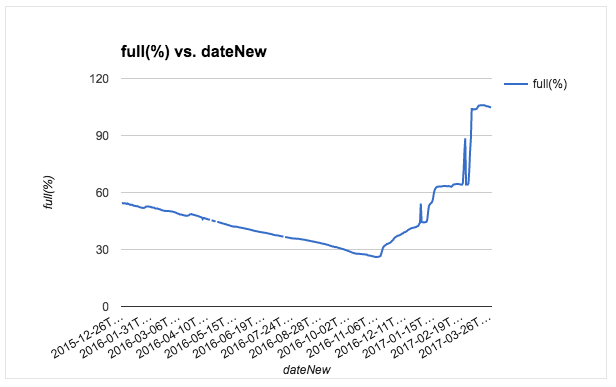
An
initial view of Vaal Dam levels for every day of the past year.
Visualising it this way makes it easy to spot anomalies or missing data
points. Those sudden spikes are very likely errors in the data rather
than actual spikes.
Another way to do initial visualisation is with one of a number of online tools. One of the easiest to use is Datawrapper
which outputs your charts in multiple different ways. It’s a useful way
to switch between different views quickly to get a sense of what works
well. There are a few other services online, such as RAW or Quartz’s Atlas charts which produce good results.
Once
you’ve got an idea of what you want to do then it’s time to start
creating. Most of the programs mentioned above will produce embeddable
versions of the charts you’ve made but they may be limited in adding
other elements like images, text areas or extra labels. For that you’ll
need to look at some other tools.
ogram
are among the best and easiest at doing this. Both make it easy to
combine charts with other visual elements, and if you start with one of
the pre-built templates you’ll have something decent looking in next to
no time.
If you’re looking for something more detailed with more than just a few default chart types then you should probably try out Tableau Public
which is free and extremely powerful. It can build everything from the
simplest charts to complete interlinked dashboards. But be warned, the
initial learning curve can be a little daunting for first-timers. If
you’re serious about data visualisation then take the time to learn more
about Tableau Public. But if you just want the occasional chart to
dress up a story then stick with one of the other options.
Part 3: Maps and mapping
If
you do any kind of data journalism you’re bound to come across
geographic data. Which brings up the issue of mapping tools, some of
which are simple point and click affairs while others border on the
arcane. So you need to think carefully about what you’re trying to
achieve with geographic data.
Too
often the first instinct is to plot the points on a map. Which is worth
doing in the initial exploratory stages in almost all cases, but often a
map is not the best way to illustrate the point of a story. For
example, having a map with 200 points all clustered around a small area
is often not the most informative way to display data. While shaded
contiguous areas to indicate some sort of distribution can be far more
effective.
Having said that, a good map done right can add huge amounts to a data story, so what are the best tools?
Once again Google is a good starting point. Google My Maps
is one of the simplest tools to use. It’s pretty intuitive to use and
makes it easy to look up geographic points, draw lines and shape on maps
and even add driving directions. If you just want to illustrate where
or how something happened geographically then there is no better place
to start.
A step up from My Maps is Google Fusion Tables.
This is also part of the Google Drive suite of tools. Fusion Tables in
fact does a lot more than just make maps, though that is one of its
strengths.
Fusion Tables also make it easy to filter data sets, do some
cleaning up of data, merge multiple datasets into one and a fair amount
more. It’s a little tricky at first but is a good choice when you’re
dealing with larger data sets.
If you’re really getting into this mapping thing and you want a bit more than the previous two options then CartoDB
is your next step. Carto is all about maps and it has the potential to
make excellent maps with multiple layers and different designs so long
as you’re prepared to put in a little initial work. Personally I find
Carto an excellent choice for mocking up a quick sample map or merging
sets of data to include geographic points. It makes it pretty simple to
visualise larger sets of data and make decisions about where you should
go with your project. Carto also makes it easy to export the cleaned and
fixed datasets into many formats which makes it easy to use in other
applications.
The world’s undersea cables as viewed in Mapshaper.org
There
are literally dozens of other applications for making maps some of
which are extremely powerful but often also very complex. ArcGIS is popular tool, as is the open source QGIS
application but both are aimed at fairly experienced mappers so the
learning curve can be steep. If you’re keen to try your hand at making
your own map styles then Mapbox is great for that. Mapshaper.org
is another of my most commonly used maps tools because it makes it easy
to get a quick visual representation of the data in your map files and
it also makes it easy to simplify map shapes, something that can be
extremely useful in keeping download times down.
In conclusion
Data
journalism is a broad area of work with place for many different
skills. Some might favour the visualisation side of data journalism
while others may prefer the mapping side. No matter what you prefer
doing or what the limitations of your newsroom are there is always
something more to be learned about data journalism. The recommended
route would be to start with the basics above and then gradually move
into some of the more detailed areas.
From
experience the best way to learn to become better at data journalism is
to practice. Find a real world dataset and see what you can make out of
it. It’s only when you’re working in a real world scenario that you’ll
really learn the ins and out of good data analysis.
Comments, thoughts, feedback? Leave a comment or find me on Twitter. Please recommend this article if you found it useful.
Programme:
The one that got away
29 dollars
Pasties and a G-string (not: Till the money runs out, as indicated on movie)
Tango
Invitation to the Blues / Eggs and Sausage
Mr. Siegal
Mathilda (Tom Traubert's Blues)